
Meet our Member: John Teal on TSI’s Torreactor and the transatlantic biomass supply chain
In this edition of Meet our Members, John Teal, Vice President of Commercial at TSI, explains how the Seattle-area engineering firm supports biomass processing worldwide, from drying and pollution control to its Torreactor® technology for carbonising biomass. He reflects on how EU rules and demand shape North American pellet markets, and why closer cooperation across the Atlantic matters as industry accelerates the shift away from fossil fuels.

Where are you based?
TSI is based out of just north of Seattle, USA, but we work around the world. We do design work at our home office and manufacture where our customers are. Our unique business model enables us to have a truly global footprint.
What does your company do?
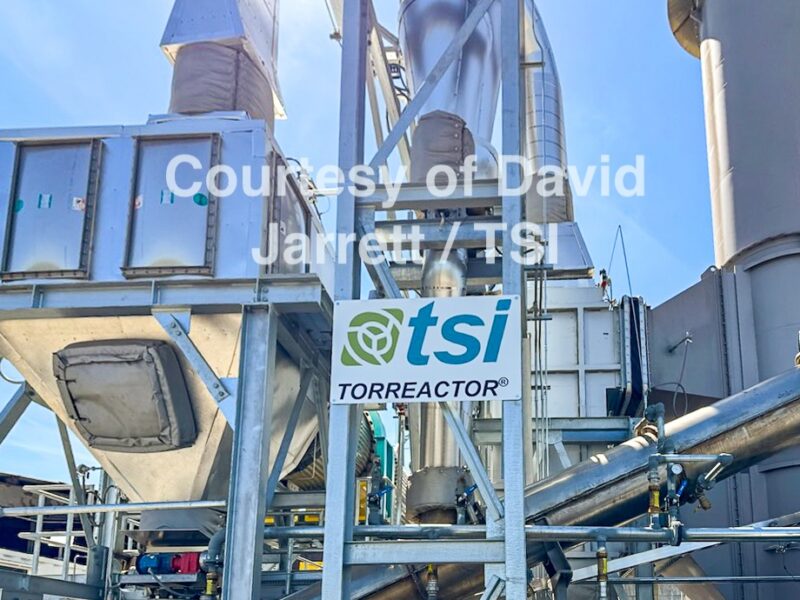
We provide equipment for the processing of forest products and biomass. TSI began in 1992, providing saw lines for the engineered wood industry. Since then, we’ve expanded our portfolio to drying and pollution control systems; lately, we have been focused on our unique Torreactor® (torrefaction reactor), which thermally upgrades/carbonises biomass.
The Torreactor® is a rotating drum that heats biomass, like wood or agricultural waste, in an oxygen-free environment, driving off moisture and gases while evenly processing the material. The result is a uniform, energy-dense, carbon-rich fuel that behaves much like coal, making it a renewable substitute for industrial use.

How is your team structured?
TSI is a very flat organisation. From its inception by my father, we’ve focused intently on in-person communication. Not only does every customer get our personal mobile number, but at home, everyone’s door is open.
Products/services and EU policy impacts
Our recent focus on wood pellets and carbonisation enables us to help our customers upgrade to biomass, allowing it to substitute fossil fuels and serve as a key link in Europe’s de-fossilisation strategy and beyond.
What value do your products and/or services bring to your customers?
We recognise that since every customer has different needs, each one deserves personal attention. We’re here to build long term relationships and enable our customers to have an impact on both the short and long term.
Our core product in carbonised biomass, the Torreactor®, can be tuned to provide thermal treatment from torrefaction to pyrolysis, which enables the feedstock to be optimised for yield and the technical demands of any end user.

Do they contribute to sustainability, efficiency, or innovation?
We enable more effective use of existing biomass and residues through thermal treatment, allowing them to offset coal and other fossil carbon fuels.
How does EU policy impact your business?
EU policy has a significant impact on our business because supply chains are closely interconnected. Europe imports significant volumes of wood pellets from North America, where there are vast sustainably managed forests along the East Coast. As a result, European policy shapes our customers’ decisions in North America and, in turn, affects our business.
What key regulations influence your operations or growth?
Europe is the largest single market for sustainable biomass consumption, while the United States, with a growth-to-drain ratio well above one and strong export logistics to Europe, remains a key source of feedstock. Consequently, regulations such as the EUDR, RED, CBAM and the UK SAF framework play a major role in shaping our operations and growth.
What motivated you to join Bioenergy Europe?
Europe is a global leader in sustainable policy and the consumption of sustainable goods, so joining Bioenergy Europe was a natural step to strengthen cooperation with partners across the Atlantic to address the shared challenge of climate change.
How does membership support your goals and industry engagement?
We sincerely value the networking opportunities and regulatory insight.
What’s next for your company?
We’ve just completed commissioning and are operating our own carbonisation unit in Georgia, USA. While small in scale at 3TPH, it demonstrates the commercial viability and operational success of the technology. We invite anyone to schdule a visit by writting to this email: torrefaction@tsi-inc.net
Related Posts
No related photos.