
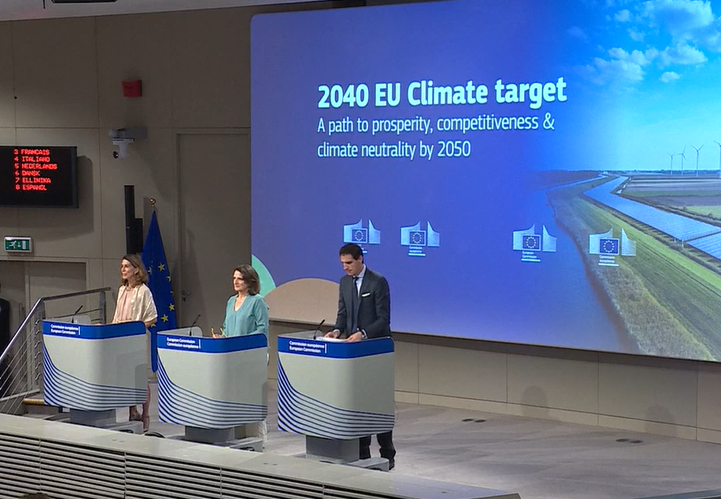
Brussels, 2 July 2025 – Bioenergy Europe welcomes the European Commission’s legislative proposal amending the European Climate Law to enshrine the 2040 climate target, a 90% net greenhouse gas emissions reduction compared to 1990 levels. This is a vital step to keep the EU on a science-based pathway to climate neutrality by 2050 and upholding its commitments under the Paris Agreement. The bioenergy sector is ready to support the EU in delivering this ambition.
A clear fossil fuel exit strategy and the promotion of sustainable bioenergy are essential to achieving this goal. Equally important is the recognition of domestic permanent removals as a necessary and complementary pillar of EU climate action.
“A 90% net reduction is the right level of ambition and now the focus must shift to implementation. Permanent carbon removals, particularly those based on biomass, are ready to contribute. What we need is a stable, long-term framework that enables investment, guarantees environmental integrity, and secures Europe’s leadership in carbon management,” insist Ennio Prizzi, Senior Policy Officer at Bioenergy Europe.
Stove The European bioenergy sector is glad to see that the Commission acknowledges the role of permanent carbon removals in meeting the EU’s 2040 target. The integration of high-integrity removals, such as Biogenic emissions Capture with Carbon Storage (BioCCS)) and biochar, into EU climate architecture sends a strong signal to innovators and investors and lays the foundation for a viable carbon management industry.
In this context, Bioenergy Europe supports the Commission’s recognition of the need to introduce targeted incentives to support domestic permanent carbon removals. In particular, the upcoming 2026 review of the EU ETS Directive presents a timely opportunity to establish a robust business case for these solutions.
By recognising the importance of permanent removals, the EU takes a decisive step toward achieving net-negative emissions in the second half of the century. This move reflects scientific consensus and aligns with the IPCC’s finding that up to 10 GtCO₂/year must be removed globally by mid-century.
“The deployment of carbon dioxide removal is unavoidable if net zero emissions are to be achieved," affirms the Intergovernmental Panel on Climate Change (IPCC) in their AR6 Synthesis Report.
We also praise the Commission’s intention to introduce greater cross-sectoral flexibility in the post-2030 climate framework. This approach can enhance cost-effectiveness, foster synergies between reduction and removal efforts, and allow sectors to contribute according to their specific capacities and opportunities.
However, to create long-term market certainty and avoid mitigation deterrence, the 2040 framework must go further and disaggregate targets into gross emissions reductions, permanent carbon removals, and LULUCF. Only by providing this clarity can the EU generate the stable demand signal required for scaling up removals at the pace needed.
Image by European Commission 2025
Related Posts
No related photos.