Bioenergy Europe at Svebio Fuel Market Day
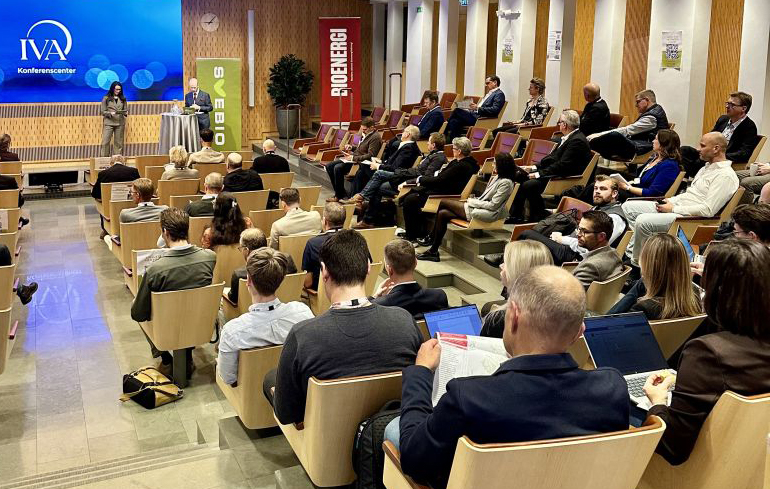
On 24 September, Bioenergy Europe joined Svebio Fuel Market Day 2026 in Stockholm, where market experts, companies and policymakers gathered to discuss how geopolitical uncertainty, changing fuel markets and EU regulation are shaping the future of European bioenergy. The Swedish Bioenergy Association, Svebio, organised the conference under the theme Fuel Markets in an Unstable World.
Bioenergy Europe Secretary General Jean-Marc Jossart joined the policy and regulation debate to examine the EU files that will most affect the sector in the coming years, with particular attention to the ongoing EU Emissions Trading System (EU ETS) revision and the future post-2030 renewable energy framework.
His intervention also caught the attention of the Swedish media. Energimarknaden, Dagens Industri’s specialist energy news service, reported on Jossart’s assessment of the ETS revision, highlighting Bioenergy Europe’s warning that while the proposal moves in the right direction on permanent carbon removals, parts of its design could weaken the system’s effectiveness.
A new role for carbon removals in the EU ETS
For Bioenergy Europe, one of the most significant elements of the Commission proposal is introducing permanent carbon removals into the ETS architecture.
The proposal foresees additional allowances corresponding to 250 million tonnes of CO₂ between 2031 and 2040 to support permanent removals, including BioCCS and DACCS.
“The current ETS revision is fundamentally a step in the right direction, because the introduction of negative emissions is genuinely something new and has potential,” Jossart told participants.
However, turning that potential into actual removal capacity will require stronger investment signals. Bioenergy Europe is calling for guarantees that planned volumes will be delivered and for contracts to be concluded early enough to allow projects to reach investment decisions.
The association is also calling for biochar carbon removal to be recognised alongside BioCCS, and to go beyond a system in which companies are not limited in using biogenic CO₂ removals.
The policy window is open now
Jossart also stressed that the political process is already moving quickly. The European Parliament and Council are now examining the proposal, making the coming weeks particularly important. The message to participants in Stockholm was therefore straightforward: companies and national associations affected by the ETS should engage while the negotiations are still open.
At the same time, attention is already shifting towards the post-2030 EU energy framework. Bioenergy Europe is calling for explicit recognition of sustainable bioenergy and greater regulatory stability. Maintaining coherent biomass sustainability rules will be particularly important for providing the certainty needed for long-term investment.
Fuel Market Day provided an important opportunity to bring these Brussels debates directly to the Swedish bioenergy sector. As the ETS revision progresses and discussions on the post-2030 framework intensify, cooperation between Bioenergy Europe and companies will remain essential to ensure that practical sector experience is reflected in EU policymaking.
Related Posts
-
European regions join forces to strengthen wood energy across Europe
September 10, 2026
-
Do not comment on the leak!
September 23, 2026